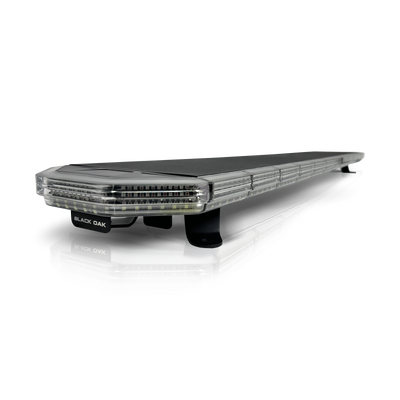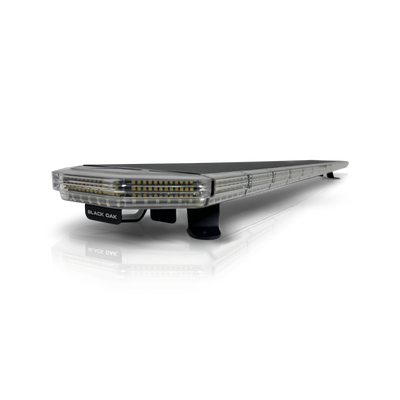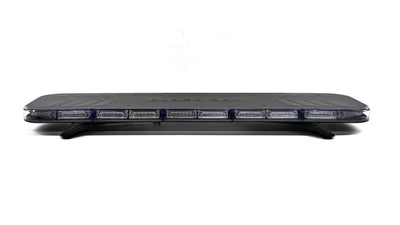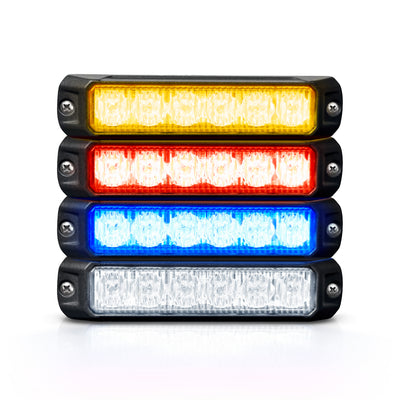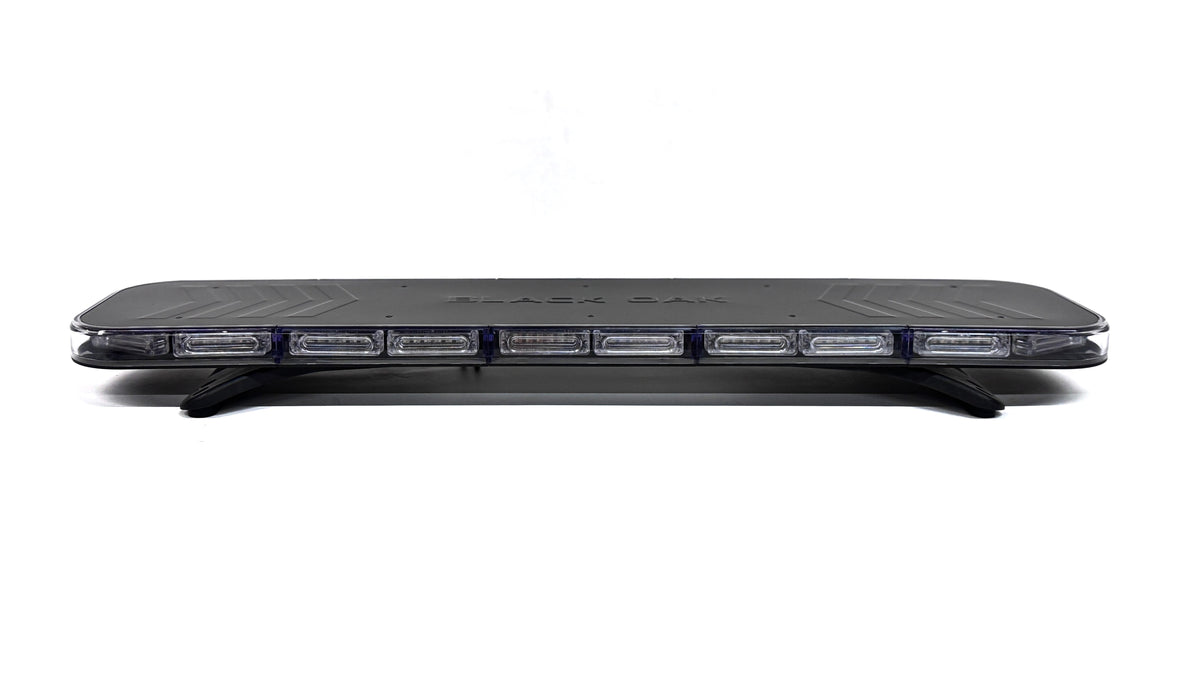
An emergency light bar has one job: make people see you and understand what they are looking at, fast enough to change what they do next. Everything else — the housing, the optics, the flash patterns, the controller — exists to serve that one job. This guide covers how to choose the right warning light for a police interceptor, a fire or EMS vehicle, a tow truck, a construction pickup, a snow plow, a security patrol vehicle or a volunteer responder's personal vehicle, and how to get the color, size, mount and wiring right the first time.
Emergency Light Bars vs Off-Road Light Bars
These are not the same product with different colors, and buying the wrong category is the most expensive mistake in this space.
An off-road LED light bar is built to push maximum usable light down a trail. It runs steady-on, it is aimed forward, and its optics are designed for distance and spread. An emergency warning light bar is built to be noticed. It fires in patterns, it throws light to the sides and rear as well as forward, and its optics are designed for signal recognition — not to help you see, but to make you unmissable.
Three practical differences follow from that:
- Flash pattern control. A warning bar needs a controller. An off-road bar needs a switch.
- 360-degree signal. Warning bars use corner and side modules so the vehicle reads as a hazard from any approach angle. A forward-facing bar leaves you invisible to the traffic most likely to hit you.
- Legal status. Warning light colors are regulated. Off-road lighting is generally restricted to off-highway use. Both are rules you have to check, and they are different rules.
Black Oak's warning lighting lives in one place: Emergency LED Light Bars, Strobe Lights & Beacons.

Warning Light Colors and What Each One Signals
Color is the first decision and the one with the least room for interpretation. What follows describes the conventions used across most of the United States — but color authorization is set by state statute and, in many cases, by your local authority having jurisdiction. Confirm your state's vehicle code and your AHJ's policy before you buy. Nothing here is legal advice, and the rules genuinely do differ across state lines.

Red and Blue — Law Enforcement
The red and blue combination is the most recognized warning signal on an American road, and in most states it is the most tightly restricted. It is generally reserved for sworn law enforcement on authorized vehicles. If you are equipping a patrol vehicle, a red and blue configuration is almost always the specification. Red & Blue is available on the 17-inch through 55-inch Low Pro bars and on every XDR strobe — the whole range is collected on our police light bars page.
The reason the pairing works is physiological as much as legal. Red and blue sit at opposite ends of the visible spectrum, so the combination stays legible in conditions where a single color washes out — red holds up in daylight and fog, blue carries further at night and against snow.
Red — Fire, EMS and Rescue
Red is the traditional fire and emergency medical color and is authorized for those services in most states. Fire apparatus, ambulances and rescue vehicles typically run red, frequently paired with white for scene lighting. Red & White is a standard option across the Low Pro range, and every length that offers it is on our fire truck light bars page.
Blue — Volunteer, Municipal and Varies Widely
Blue is where the state-by-state differences bite hardest. In some states blue is law enforcement only. In others it is authorized for volunteer firefighters, and in a few it signals a specific service entirely. This is the single color most worth verifying against your own statute before ordering.
Amber — Tow, Construction, Utility, Plow and Everything Non-Emergency
Amber light bars are the workhorse of this category. Amber is the most broadly permitted warning color in the country and it covers the largest share of vehicles that legitimately need to be seen without claiming emergency status:
- Tow trucks, wreckers and roadside recovery
- Construction, paving and DOT maintenance vehicles
- Utility, electrical and pipeline service trucks
- Snow plows and municipal fleets
- Escort and oversize load vehicles
- Security patrol, airport ground support and campus fleets
- Agricultural equipment moving on public roads
Amber also has a practical advantage: it penetrates snow, rain, dust and fog better than the cooler colors, because shorter blue wavelengths scatter more in airborne particulate. If your work happens in weather, amber is doing more than satisfying a regulation.
Amber and White — The Tow and Construction Standard
Most working tow and construction builds end up on Amber & White rather than pure amber. Amber does the warning; white gives you takedown and scene light so you can actually work at the hook or in the cone zone. Amber & White is available in every Low Pro length — on the 61-inch and 68-inch it comes as part of the Tow Package configuration, which is what those two lengths are built around. Both sit at the top of our tow truck light bars page alongside the rest of the recovery range.
Green — Command, Incident Command and Specialty
Green has grown in use for incident command, mobile command posts and certain security and industrial roles. Amber & Green is available on the 17-, 30-, 43- and 49-inch Low Pro bars, and the XDR-48 offers White / Green and Amber / White / Green — useful where a command vehicle has to be distinguishable from the units it is directing.
White — Takedown, Alley and Scene
White is not usually a standalone warning color, but it is essential as a secondary. It is what turns a warning bar into a work light when you are stopped: takedown to the front, alley to the sides, scene to the rear.
Know the Rules Before You Order
Warning lighting is one of the few product categories where the wrong purchase can be a citation rather than an inconvenience. Before you configure anything:
- Read your state's vehicle code section on warning lamps. Every state has one. It will specify which colors are authorized for which classes of vehicle, and often when they may be displayed.
- Check with your AHJ or fleet authority. Departments frequently have policies stricter than state law, particularly around blue and around personally-owned vehicles.
- Ask whether a permit is required. Volunteer responders using a personal vehicle often need one, and it is usually tied to a specific color and configuration.
- Confirm what your customer or contract requires. DOT contracts, airport ground operations and utility contracts routinely specify a standard you must meet on paper, not just in practice.
If a contract or department policy names a specific certification class, send us the requirement and we will confirm in writing what satisfies it before you order. We would rather lose an order than have you fail an inspection.
SAE J845 and What Class 1, Class 2 and Class 3 Actually Mean
SAE J845 is the industry standard for optical warning devices on ground vehicles. It defines how much light a warning device must put out, measured across a set of horizontal and vertical angles, and it sorts devices into three classes by intended use:
- Class 1 — the highest output tier, intended for use where the device must command attention in high-speed traffic. This is what emergency response and highway work specifications typically call for.
- Class 2 — an intermediate tier for lower-speed environments and situations where the device supplements other warning.
- Class 3 — the lowest tier, intended for slow-moving vehicles, off-road work and controlled environments such as yards, warehouses and airside operations.
Two things are worth understanding about how the standard behaves. The classes describe photometric performance across measured angles — they are not a lumen rating, and a bar with a bigger lumen number on the box is not automatically a higher class. And the term gets used loosely across this industry: plenty of bars are advertised as "Class 1 style" or "meets Class 1 output" without being certified to anything.
Black Oak's Low Pro emergency light bars are SAE J845 and J595 Class 1 certified, IP69K sealed, and backed by our lifetime warranty on this line. That matters most when you are buying against a written specification — a DOT contract, a municipal fleet standard, an airport ground operations requirement — because those specs are usually satisfied on paper before anything gets installed. When you evaluate any vendor, including us, ask for the standard and the class in writing against the exact configuration you intend to order.


Sizing: Matching Bar Length to Vehicle and Role
Black Oak's Low Pro emergency line runs seven lengths. The right one is a function of roof width, mounting surface and how much of the vehicle you need the signal to cover.
| Length | Typical role | Price from |
|---|---|---|
| 17" | Interior dash and deck mount, compact SUV, UTV, forklift, security cart, supervisor vehicle | $349.37 |
| 30" | Mid-size truck, service body, plow truck, escort vehicle, headache rack mount | $615.62 |
| 43" | Half-ton and three-quarter-ton pickup, tow truck, utility body, most fleet trucks | $767.50 |
| 49" | Full-size pickup and SUV, patrol vehicle, ambulance, heavy wrecker | $950.62 |
| 55" | Full-width roof coverage on full-size trucks, rollback carriers, DOT trucks | $1,060.62 |
| 61" | Heavy truck, dual-rear-wheel chassis, apparatus, snow plow with wing | $1,299.38 |
| 68" | Maximum coverage — fire apparatus, heavy recovery, oversize escort | $1,549.38 |

Two sizing rules that save returns. Measure the usable flat of the roof, not the roof's overall width — most modern trucks curve at the edges and the crown of the cab is narrower than it looks. And size for the widest thing you need seen: on a rollback or a plow truck, the signal has to cover the load or the blade, not just the cab.
For a multi-color build in a mid-size footprint, the XDR-48 Emergency Light Bar runs up to three colors in one housing, including Amber / Red / Blue and Amber / White / Green — useful where one vehicle changes role, or where a command unit needs to be distinct from its own fleet.
Mounting: Permanent, Door Jamb, Headache Rack or Magnet
Every Low Pro bar ships with a bracket choice, and it matters more than most buyers expect. Availability varies by length, so check it before you settle on a size:
- Headache Rack — every length, 17 to 68 inches.
- Door Jamb — 30 inches and up. Not offered on the 17-inch.
- Magnet — 17, 30 and 43 inch only. If you need a no-drill install, you are choosing from those three lengths.

Door Jamb
The clean permanent install. Brackets pick up the door jamb structure and hold the bar low and tight to the roof, which is where the "Low Pro" profile earns its keep — less wind noise, less fuel penalty, less visual bulk. This is the right choice for a dedicated vehicle that will wear the bar for its whole service life.
Headache Rack
For service bodies, plow trucks, tow trucks and any truck already running a rack. Mounting to the rack puts the signal higher and further back, which is usually better for a working truck: the bar clears the load, stays visible over whatever is on the deck, and does not require drilling the cab.
Magnet
The answer for anything that cannot be permanently modified — a personal vehicle, a leased fleet truck, a supervisor vehicle that rotates, an escort vehicle used a few times a month. Magnetic mounting also matters for volunteer responders whose permit may only authorize warning lights while responding.
For temporary use where even a full bar is more than the job needs, the XDR-4 Amber Warning LED Beacon and the XDR-2 Mini Amber Warning LED Beacon both offer a magnetic mounting option alongside permanent.
Flash Patterns, Controllers and Cable Runs
A warning bar without pattern control is just a bright light. The controller is what lets you match the signal to the situation: an aggressive pattern while responding or approaching a scene, a slower steady pattern while parked and blocking, and takedown or scene light when you are working.
The detail that catches people out is cable length. Low Pro bars from 30 inches up ship with a standard 12-foot controller lead, with 22-foot and 27-foot total options available; the 17-inch ships with its lead fixed. Before you order, run the actual route: roof to headliner, down the A-pillar or through the jamb, along the kick panel, to wherever the controller will actually live. On a crew cab with the controller in the console, or on any truck where the head unit mounts in the rear, the standard lead is often short. Ordering the extension up front costs less than splicing one in later.
Application Build Sheets

Police Interceptor and Patrol Truck
Red & Blue, sized to full roof coverage — 49" on a full-size SUV or pickup, 43" on a mid-size. Door jamb mount for the permanent install and the low profile. Add XDR-5 strobes in Red & Blue at the grille and rear for the approach angles a roof bar cannot cover. Shop the range: police light bars.
Fire, EMS and Rescue
Red or Red & White on a 49" or 55" bar. Worth knowing before you spec a longer one: the 61-inch and 68-inch are built around Tow Package configurations and do not offer a plain Red option — the longest bar available in plain Red is the 55-inch. If you want length and red, the 61 and 68 inch offer Red & White With Tow Package. White secondaries earn their place here — you will be working the scene in the dark far more often than you will be running lights and siren. Shop the range: fire & EMS light bars.
Tow Truck and Wrecker
Amber & White is the configuration. Length follows the truck: 43" on a light-duty wrecker, 55" on a rollback so the signal covers the deck, 61" or 68" on heavy recovery. The 55, 61 and 68 inch bars offer a dedicated Tow Package configuration — that is the option built for this job. Headache rack mount if the truck has one. Add XDR-4 strobes at the rear of the bed — roadside recovery is rear-end collision territory and the rear signal is the one that protects you. Shop the range: tow truck light bars.
Construction, Paving and DOT
Amber, or Amber & White where crews work after dark. A 30" or 43" bar covers most crew pickups; DOT trucks running a shadow or blocking role want 55" or longer. Check the contract first — many DOT and municipal specifications name a required standard. Shop the range: amber light bars.
Snow Plow
Amber, mounted high and far enough back to be seen over the blade and any wing. Headache rack mount, and size for the widest point of the plow rather than the cab. Amber's advantage in falling snow is the whole reason it is the plow standard.
Security Patrol and Campus Fleet
Amber in almost every jurisdiction — security vehicles are generally not authorized emergency vehicles. A 17" deck or dash bar or a magnetic XDR-2 beacon is usually the correct amount of light for a patrol car, cart or gate vehicle.
Volunteer Responder, Personal Vehicle
Verify your authorization first — color and configuration for POV use are frequently defined by permit, and blue in particular varies by state. Then choose magnetic mounting so the vehicle can be returned to a civilian state, and keep the footprint modest: a 17" bar or a pair of XDR-5 strobes is the typical build.
Utility, Fleet and Escort
Amber, sized to the vehicle, with mounting chosen around whether the truck is owned or leased. For mixed fleets, standardizing on one bar length and one bracket type across the fleet makes spares and replacement dramatically simpler — worth more over five years than optimizing each truck individually. For fleet and government quoting, send us the vehicle list and we will spec it as a set.
When a Beacon or Compact Strobe Beats a Full Bar
A full-length bar is not always the right answer, and it is frequently the wrong one on a vehicle that only occasionally needs to be seen. The compact options are collected on our LED emergency strobe lights and beacons page.
- XDR-4 Amber Warning LED Beacon — $106.24, permanent or magnetic. The classic single-point rotating-style warning signal for utility, agricultural, yard and escort work.
- XDR-2 Mini Amber Warning LED Beacon — $85.94. Same idea in a smaller footprint, for carts, compact vehicles and equipment.
- XDR-5 Emergency Strobe — $46.50, in nine color configurations including Red & Blue, Amber & White and Blue & White. Surface-mount modules for grille, bumper, rear and side positions.
- XDR-4 Emergency Strobe — $37.45. The most cost-effective way to close a coverage gap, and the right way to add rear and side signal to a truck that already has a bar.
The most common real-world mistake is a truck with a good roof bar and nothing at the rear. Traffic approaching from behind at speed is the threat that actually hurts people working a roadside. A pair of rear-facing strobes is the cheapest safety upgrade in this entire category.
Power, Wiring and Amp Draw
Warning bars draw more current than an off-road bar of the same length, because more modules are firing and the controller is running. Three rules:
- Relay everything. A warning bar should never be switched through a dash switch's own contacts. Use a relay and fuse it at the battery. Our wiring kits cover the standard installs, and the relay wiring walkthrough applies directly.
- Size the alternator honestly. A truck running a full bar, takedown, scene light and a radio at idle for hours at a scene is a different electrical load than one driving down a highway. Idle-time charging is where fleet electrical problems start.
- Protect the run through the jamb. Every cable that crosses a door opening needs a grommet and slack. This is the single most common cause of an intermittent warning light two years after install.
Fleet and Government Purchasing
If you are buying for a department, a municipality or a commercial fleet rather than a single truck, a few things change. Standardize configuration across the fleet so spares are interchangeable. Get any required certification confirmed in writing against your exact configuration before the first unit ships, not after. Plan bracket type around your ownership model — leased vehicles usually mean magnetic. And build in spare strobe modules from the start; they are the component most likely to need replacement and the cheapest to hold in stock.
Black Oak builds and ships from Sarasota, Florida. For fleet quoting, spec confirmation or a vehicle-by-vehicle build list, send us your requirement and we will put it together as a package.

Fleet, municipal and government pricing
Volume pricing, spec confirmation in writing, and a build list put together vehicle by vehicle. SAE J845 and J595 Class 1 certified, IP69K sealed, lifetime warranty on the emergency line.
Request Fleet PricingFive Mistakes That Cost the Most
- Buying the color before checking the statute. Especially blue. Especially on a personal vehicle.
- No rear signal. A roof bar alone leaves your most dangerous approach angle uncovered.
- Measuring the roof instead of the usable flat. Returns in this category are overwhelmingly a size problem.
- Taking the standard 12-foot controller lead without routing the run. Order the 22-foot or 27-foot option if the controller lives anywhere but the front console.
- Buying an uncertified bar against a spec that requires one. "Class 1 style" and "Class 1 output" are not certifications. If the contract names a standard, get the standard and the class in writing from whoever you buy from.
Shop by Application
Each of these pages holds only the bars and strobes available in that configuration, with sizing and the colour rules for that use:
- Amber light bars — tow, construction, utility, plow, escort, agricultural and security. No permit required in any state.
- Tow truck light bars — the Amber & White and Tow Package builds, with the 61-inch and 68-inch recovery bars leading.
- Fire & EMS light bars — every Red & White configuration, apparatus through volunteer POV.
- Police light bars — the Red & Blue range, 17-inch through 55-inch, marked and unmarked.
- LED emergency strobe lights & beacons — surface-mount strobes, 360-degree beacons and mini bars.
Keep Reading
Emergency lighting shares most of its engineering with the rest of the catalog, and these guides go deeper on the parts this page only introduces:
- How to wire a relay — the correct way to switch any high-draw bar, warning or otherwise.
- How to wire a light bar — the full install walkthrough, including routing a run through a door jamb.
- Light bar mounting locations — where a bar actually belongs on a given vehicle.
- Amber vs white LED lights — why amber wins in snow, dust and fog, in more depth than the color section above.
- All install and wiring guides and all truck and vehicle guides.
Browse the full range at Emergency LED Light Bars, Strobe Lights & Beacons, see fleet and government pricing, or read the rest of our emergency and first response guides.