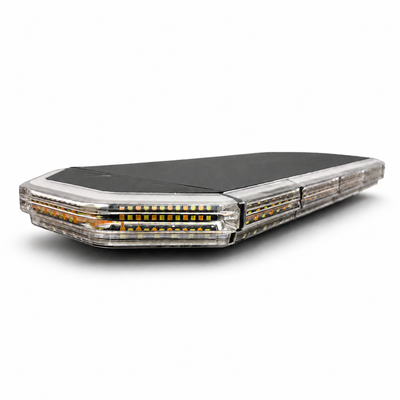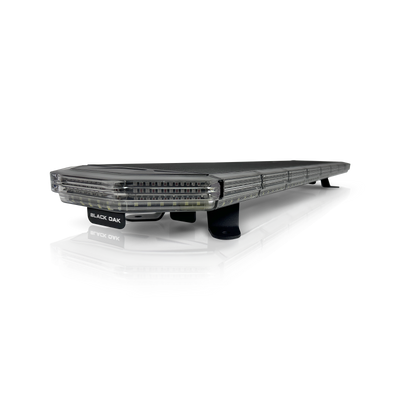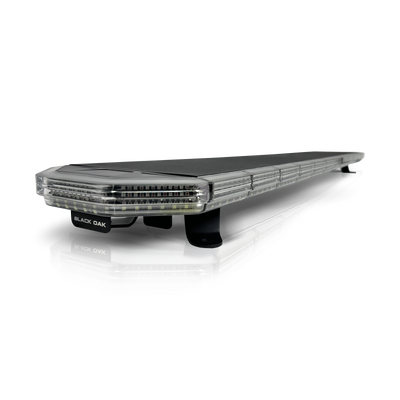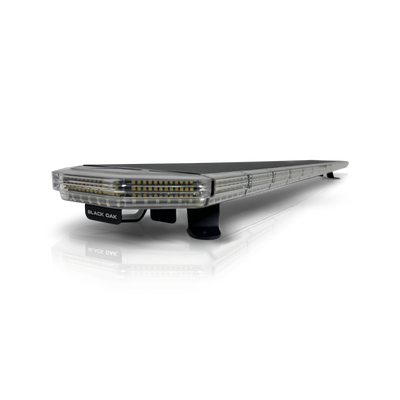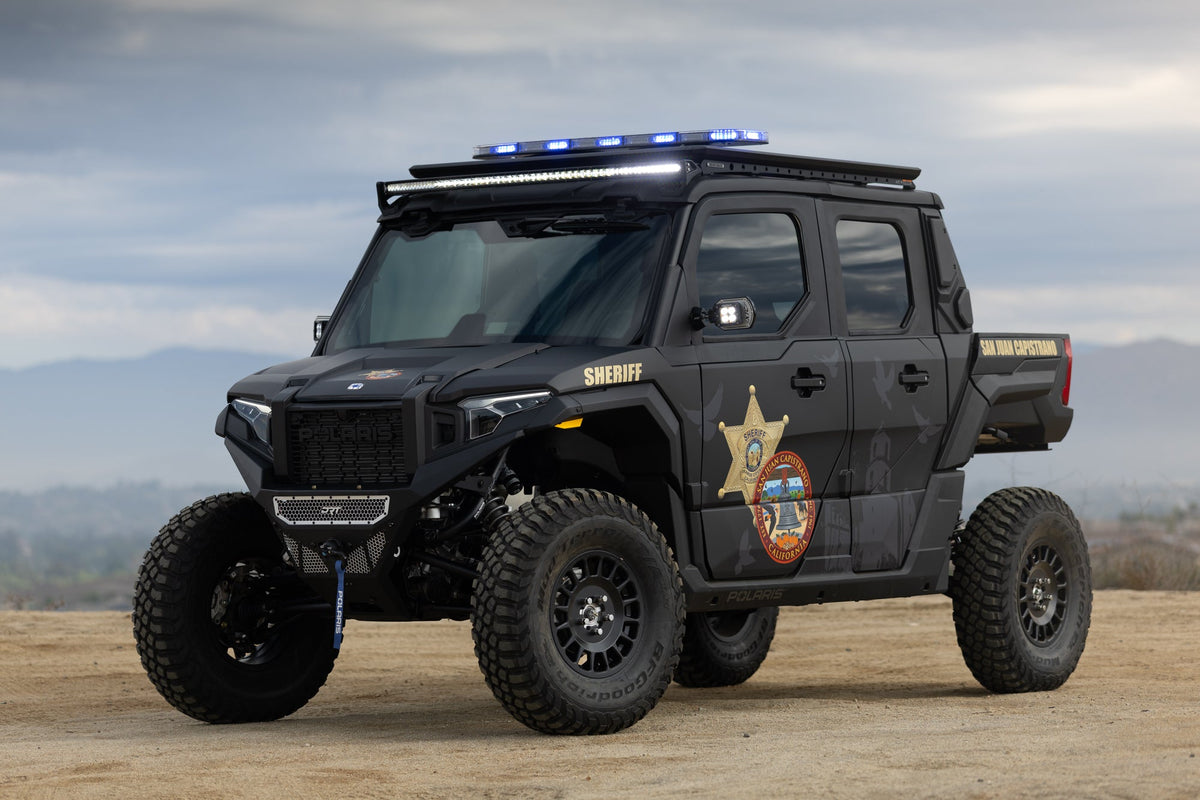

Most patrol light bar mistakes happen before the bar is ever unboxed: the wrong color configuration for the agency, red and blue on the wrong sides, or a length that overhangs the roof or leaves the rear quarter dark. This guide covers the five decisions that matter for a police or sheriff vehicle, in the order a fleet manager or upfitter actually makes them. Every configuration below is available on the Black Oak LED police light bar collection, built on the Low Pro platform, certified to SAE J845 and SAE J595 Class 1, and designed and engineered in Sarasota, Florida.
1. Who can run red and blue

Red and blue warning lights are reserved for authorized emergency vehicles in every U.S. state: law enforcement, fire, and EMS units operated by an agency. A privately owned vehicle cannot legally display red and blue on a public road, and most states treat even a parked, unlit red and blue bar on a civilian vehicle as a violation. Volunteer firefighters and EMTs fall into a separate category that varies by state: some states allow a blue courtesy light, some allow red, and some require a permit issued through the department. If you are outfitting a volunteer or personally owned vehicle, get the authorization in writing from your department before ordering a colorway.
| Colorway | Who runs it | Authorization |
|---|---|---|
| Red and blue | Police, sheriff, state patrol, many EMS units | Authorized emergency vehicles only |
| Red, red and white | Fire apparatus, chief and command vehicles, EMS | Authorized emergency vehicles only |
| Blue | Volunteer courtesy light in some states, police in others | Permit or department authorization, varies by state |
| Amber, amber and white | Tow, plow, utility, construction, escort | Working vehicles; most states allow, some require a permit |
Two practical consequences follow. First, the vehicle's authorization determines the colorway, not the other way around, so order the configuration your agency is permitted to run. Second, the same Low Pro bar is available in red and blue, blue only, red only, red and white, and amber and white, so an agency can standardize on one platform across patrol, supervisor, and support vehicles and change only the color configuration. If your fleet also runs tow, plow or utility units, the amber warning light laws by state guide covers that side.
2. Red on the driver's side, blue on the passenger's side

This is the convention U.S. agencies follow and the standard every Black Oak LED red and blue bar, render, and install photo uses: red modules on the driver's side of the vehicle, blue modules on the passenger's side. Standing in front of the vehicle looking at it, red is on your right and blue is on your left. From the rear, red is on your left.
State law regulates which colors an agency may display and, in some states, which direction they may face. It does not regulate which side each color sits on, so this is an agency and upfitter convention rather than a statute. The reason to follow it anyway is consistency: when every unit in a fleet runs the same layout, the roof bar, the grille strobes, the mirror lights and the rear deck all read as one system to other drivers. Mixed layouts across a fleet are one of the more common upfit errors we see on trade-ins.
On a dual-color Low Pro, every module can display either color, so the split is set on the controller rather than fixed in the housing. Set red to the driver's side, blue to the passenger's side, then sync the supplemental lights to match.
3. Which length fits the patrol vehicle

Length is a roof-width decision first and a coverage decision second. A bar that runs edge to edge across the roof looks purposeful and gives full 360 degree presence; a bar that stops well short of the rails leaves the rear quarters darker and reads as an afterthought. The Low Pro is offered in eight lengths so the fit can be matched to the vehicle rather than compromised.
| Length | Typical patrol use | Mounts available |
|---|---|---|
| 49" | Full-size patrol SUVs and full-size sedans. The default recommendation for most marked units. | Door jamb, headache rack |
| 43" | Full-size SUVs and half-ton pickups where a narrower roofline or a roof rack limits width. | Door jamb, magnet, headache rack |
| 30" | Mid-size SUVs, unmarked and supervisor units that want a lower visual profile. | Door jamb, magnet, headache rack |
| 17" | Pickups, UTVs and rear-facing or secondary positions. | Magnet, headache rack |
| 55", 61", 68" | Full-size pickups, command vehicles, apparatus and heavy-duty units. | Door jamb, headache rack |
Measure the roof between the outer edges of the drip rails or roof rails, then choose the longest bar that fits inside that measurement. On a full-size patrol SUV that is usually 49 inches. If the vehicle carries a factory roof rack, the 43 inch bar clears most rail spacing.
4. Mount, cable and controller

Door jamb mount is the permanent patrol installation: the feet bolt to brackets that mount behind the door seal, with no holes through the roof. It is the right choice for a marked unit that will carry the bar for the life of the vehicle. Headache rack mount is for pickups and support trucks that carry a rack. Magnetic mount is for unmarked, temporary, or shared-pool vehicles, available on the 17, 30 and 43 inch bars.
Every Low Pro ships with a controller and a 12 foot lead. On the 30 inch and larger bars you can select a 22 foot or 27 foot total run at checkout, which covers a cab-to-bed run on a pickup or a long-wheelbase SUV without splicing. Decide the cable length before ordering; it is the item most often reordered after the first install.
5. Sync the roof bar with the grille and rear
A roof bar alone leaves the vehicle dark below the beltline, which is where an approaching driver's eyes sit in traffic. The standard patrol package adds a pair of XDR-5 surface mount strobes in the grille and a second pair on the rear deck or tailgate, wired to the same split as the roof bar: red on the driver's side, blue on the passenger's side, front and rear. Run every red module in sync and every blue module in sync so the vehicle reads as one signal from any angle instead of three unrelated lights.
Certification and compliance

The Low Pro emergency light bar is certified to SAE J845, the 360 degree warning lamp photometric standard for light bars and beacons, and to SAE J595 Class 1, the highest intensity class and the one approved for primary emergency vehicles. The housing is IP69K sealed, rated for pressure washdown, salt and dust, and the bar operates from minus 40 to plus 145 degrees Fahrenheit. Certification documentation and spec sheets are available on request for procurement offices. Because warning-equipment regulations vary by state and by agency, confirm color and mounting requirements with your authority before the bar is installed.
Fleet and department orders
Agencies outfitting more than one vehicle can request a quote for mixed sizes and colorways, mount hardware, and controller cable lengths in a single order. Contact sales or call 1-800-348-1287. For the broader buying decision across police, fire, tow and plow applications, start with the emergency light bar buying guide, the tow truck light bar requirements guide, or go straight to the full emergency light bar collection.
Backed by warranty, see each product page for details. Designed and engineered in Sarasota, Florida.