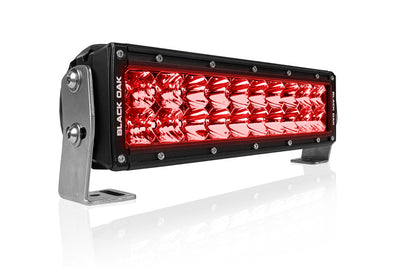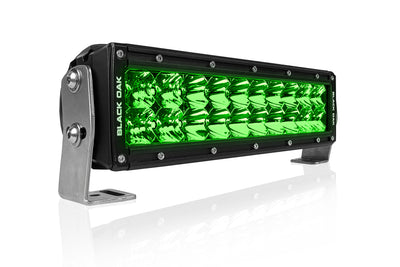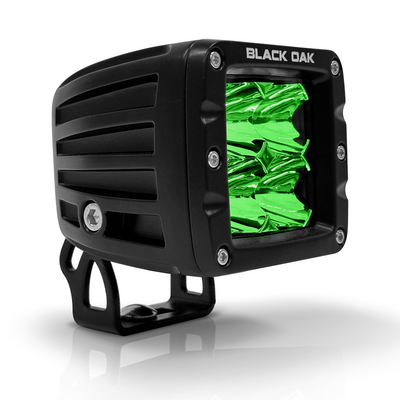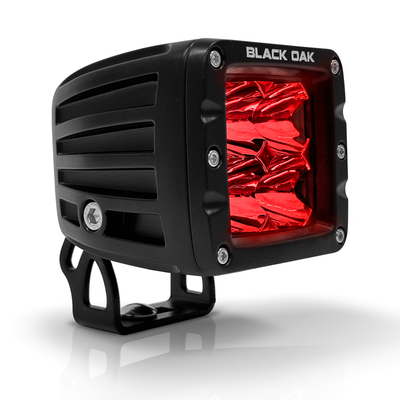
Quick answer: which hunting light color should you use?
- Red (about 660 nm): the lowest-signal visible color for scanning and calling coyotes, and the easiest on your own night vision. Browse hunting LED lights.
- Green (about 520 nm): more detail and reach for you, and a steady signal for hogs over feeders and fields. See the red and green hunting lights.
- Infrared (850 or 940 nm): no beam for the animal to react to, but it only works through night vision optics or an IR camera. See infrared light bars.
Ask five predator hunters which light color to run and you will get five confident answers. Red, green and infrared all work by giving you light the animal handles differently than white, and the right pick depends on what you hunt, how pressured it is and what optics you run. Below is what the vision research says, what it does not say, and how that translates into a setup.
What can coyotes, hogs, deer and raccoons actually see?
Color vision comes from cone cells in the retina, and the species you hunt have far fewer cone types than you do. The chart plots published cone peak sensitivities against the two visible colors we build, so you can see how far each light sits from what each animal's cones respond to.
Three things stand out. Hogs and canids are dichromats, so they only get two cone signals, one near the blue end and one in the green-yellow region. A 660 nm red LED sits about 100 nm past the long-wavelength cone peak, which is why red is such a weak signal for them while it looks vivid to you. A 520 nm green LED lands close to that long-wavelength cone, so hogs and coyotes can see it. And raccoons are the exception to the usual dichromat shorthand: the work on raccoons found a single cone class, so they do not see color at all. Visible does not mean alarming, though. Movement, wind and noise matter at least as much as color, and a pressured animal can bolt from any beam.
Red, green or infrared: how do they compare?
The table lines the three up on what hunters ask about most. The first row reflects the vision data above, not a guarantee of how any one animal will behave.
| Red | Green | Infrared | |
|---|---|---|---|
| Signal to the animal | Very weak | Visible, steady | No visible signal |
| Detail to your eye | Lowest | Highest of the three | Depends on the optic |
| Your own night vision | Preserved the most | Moderate | Not applicable |
| Special optics needed | No | No | Yes |

Which color fits the animal you are hunting?
Start with red. A 660 nm light is a weak signal for a canid, it keeps your dark adaptation, and it lights eye shine well, which is how most callers pick out a coyote coming in. Scan with a wide or diffused red, then use a red spot to hold the animal.
Shop the 2 inch red predator pod, the red diffused pod, or a 10 inch red predator bar. Our full red breakdown is in Choosing the Best Red Hunting Light.
Green for detail, red when they are wary. Hog cones peak at 556 nm, so green is easy for you to read and a calmer signal than white. If the sounders are pressured and spooking at everything, drop to red or go infrared.
Shop the 2 inch green hog pod or the 10 inch green hog bar. For a longer reach across a field, the 20 inch green bar covers more ground.
Color is not the lever here. Raccoons have one cone type, so red, green and white all read as brightness rather than color. Pick the light for your own needs: red keeps your eyes adapted, green shows more detail, and a diffused pattern avoids glare off nearby brush.
The red diffused pod and green diffused pod have an even close-range spread.
Go infrared. Nothing visible leaves the light, so there is no beam to react to. Pair a vehicle- or tripod-mounted IR illuminator with a digital night vision scope or camera and size it to the range you shoot.
Shop the 850 nm pod, the 940 nm pod, or the 20 inch 850 nm and 940 nm light bars. More on IR in our infrared light bar guide.
850 nm or 940 nm: where does infrared sit?
850 nm LEDs show a dim red glow at the emitter when you stand close. 940 nm LEDs show nothing. The trade is range: typical camera and scope sensors are more sensitive at 850 nm, so the same power usually reaches farther at 850 than at 940. Infrared output is not measured in lumens, so compare IR lights by wavelength, wattage and beam angle instead.
What do you need to run infrared?
Infrared setup checklist
- An IR illuminator. Black Oak infrared pods and light bars use real IR LEDs, not filters. The 2 inch pods are 12W with 4 LEDs and a 15 degree spot or 45 degree flood.
- A night vision optic that can see it. A digital night vision scope, night vision device or an infrared-sensitive camera. Without one the light does nothing for your eye. If you want a camera and screen, see the Nitron night vision camera guide.
- The right wavelength. Check your optic's specification: 850 nm for the most reach, 940 nm when you want no visible glow.
- Power and wiring. The pods run on 10 to 30V DC and ship with a 12 foot harness, fuse, relay and switch.
- A mount and aim point. Mount the illuminator on your vehicle, stand or tripod and aim it where your optic is looking.
- Eye safety. Do not stare directly into an IR light.
What does a purpose-built hunting light bar look like?

Every Black Oak light is IP69K rated, which means a sealed housing tested against high-pressure, high-temperature water jets and dust, and the housings use a military-grade breather to keep moisture out. For hunters that means rain, mud, wash-downs and cold mornings are not a concern for the light. The red and green bars use true colored LEDs, not a filter over a white LED, so there is no white leakage around the edges.
Shop by color
Red, about 660 nm
Scanning and calling predators 2 Inch Red Predator Pod12W, 4 LEDs, spot 15 degrees or flood 45 degrees
 2 Inch Red Diffused Pod12W, 85 degree diffused pattern for close scanning
 10 Inch Red Predator Light Bar60W, 20 LEDs, combo optics, 4A at 12 to 30V
 20 Inch Red Predator Light Bar20 inch curved double row, combo optics
Green, about 520 nm
Hog work over feeders and fields 2 Inch Green Hog Pod12W, 4 LEDs, flood 45 degrees
 2 Inch Green Diffused PodDiffused pattern for camp, feeder and close work
 10 Inch Green Hog Light Bar60W, 20 LEDs, combo optics, 4A at 12 to 30V
 20 Inch Green Hog Light Bar20 inch curved double row, combo optics
Infrared, 850 and 940 nm
For night vision optics and cameras 2 Inch 850nm IR Pod12W, 4 LEDs, spot 15 or flood 45 degrees
 2 Inch 940nm IR Pod12W, 4 LEDs, spot 15 or flood 45 degrees
 20 Inch 850nm IR Light Bar20 inch double row, 850nm infrared
 20 Inch 940nm IR Light Bar20 LEDs, 100W (5W) or 60W (3W) build
Red, green and infrared FAQ
Can coyotes see red light?
Can hogs see green light?
Is red or green better for hog hunting?
Can deer see red or green light?
Can animals see infrared light?
Should I choose 850 nm or 940 nm infrared?
Do I need special optics to use an infrared light?
Does a red hunting light preserve my own night vision?
Sources
- Neitz J, Jacobs GH. Spectral sensitivity of cones in an ungulate. Visual Neuroscience, 1989 (domestic pig: cone peaks 439 and 556 nm).
- Jacobs GH, Deegan JF, Crognale MA, Fenwick JA. Photopigments of dogs and foxes and their implications for canid vision. Visual Neuroscience, 1993 (cone peaks near 430 to 435 and 555 nm).
- Jacobs GH, Deegan JF. Cone photopigments in nocturnal and diurnal procyonids. Journal of Comparative Physiology A, 1992 (raccoon and kinkajou monochromatic).
- UGA Research Magazine, Summer 2005, on work by Miller, Jacobs and D'Angelo (white-tailed and fallow deer red-green colorblind).
- Black Oak LED product specifications for wattage, beam angle, voltage and IP rating, checked Oct 2, 2026. LED colors are nominal.
Night hunting rules, including which species you may take and when artificial light is allowed, vary by state and county. Check your local regulations before you hunt.
Designed and engineered in Sarasota, Florida. Questions about your setup? Call 1-800-348-1287 or see the hunting lights guide.