
Congratulations to Steven H. on Winning Black Oak's October Giveaway!
October's winner compared every night vision camera on the market, called the engineers at each brand, and then picked ours. Here's the reasoning — and what it looks like from the helm of a Ranger Tug on the Gulf at midnight.
The PrizeWhat Steven Won
20-Inch Double Row LED Light Bar – Pro Series 3.0
A 20-inch Double Row for the boat. IP69K sealed, Osram chipsets, and the same lifetime warranty behind everything we build. Steven's reply when we told him he'd won was characteristically understated: "The light bar will be fine and greatly appreciated."
$680 ValueThe BoatA Ranger Tug That Doesn't Sit Still
Steven and his wife run a 2019 Ranger Tug R-29 CB. It's moored in Munising, Michigan — the gateway to Pictured Rocks National Lakeshore on Lake Superior — but calling that its home is only half the story. They've trailered the boat over 8,000 miles since 2024 and lived aboard roughly a quarter of the year for the last couple of years.
A typical year: a month or two on Florida's Gulf Coast, back up to Michigan for the summer, and whatever waters look interesting in between. Last month it was Lake Cumberland.
That range is what makes his report useful. The same camera has worked the crab-pot minefields of the Gulf, a Lake Cumberland shoreline with essentially zero ambient light, and the ICW running south toward Miami in daylight. Not many reviews cover that much water.
In His Own WordsWhy Steven Bought It
"I installed the XR1 in the spring of this year after some uncomfortable nighttime travels in Florida trying to avoid crab pots played out like landmines in the Gulf."
"I decided to install the XR1 over other brands after I compared everything available. I even talked to engineers at all brands."
— Steven H., October 2026 Giveaway WinnerRead that second sentence again. He didn't read reviews — he called the engineering departments. At every brand. That's the kind of buyer who is genuinely difficult to win, and the kind whose conclusion is worth more than a hundred impulse purchases.
Three things decided it for him, and all three are worth understanding whether you end up buying from us or not.
Reason OneWired, Because Latency Is Not Negotiable
Steven ruled out every wireless camera on the market, and his reasoning was blunt:
He's right, and it matters more on the water than people expect. A wireless video link has to encode the frame, packetize it, transmit it, and decode it on the other end. Even a good one adds delay. On a boat closing on an unlit obstacle, the picture you're steering by needs to be the picture that exists right now — not the one from a fraction of a second ago.
The XR1 runs a hard-wired video feed into his chart plotter. He's running a Garmin GPSMAP 7612, and because it's an older unit he specified the configuration with RCA video connections to match it. Worth knowing if you've got existing electronics at the helm you'd rather keep than replace.
Reason TwoRadar Tells You Something Is There. It Doesn't Tell You What.
Steven already had radar and chart plotters aboard. He wasn't filling a hole in his electronics — he was closing a specific gap in them.
That's the whole problem in two sentences. Radar is superb at finding large, hard, reflective things at distance. It is much less good at small, low, soft, wet objects sitting at the surface — which is an exact description of a crab pot buoy or a net marker. And when radar does return something, it hands you a blob and leaves the identification to you.
A camera answers the question radar raises. Is that a channel marker or a piling? A tender at anchor or a floating log? You stop guessing and start seeing.
Reason ThreeColor, Because You Can't Read a Thermal Image
This was the one that settled it. Steven looked hard at thermal imaging and concluded it couldn't do the specific jobs he needed done.
Thermal cameras see heat, not light. That's a genuine superpower in some situations — a person in the water, an engine running hot, something warm against a cold background. But a thermal image has no color information in the ordinary sense, and it can't resolve printed text. A red daymark and a green one are the same temperature. A sign is the same temperature as the post it's bolted to.
For navigation, where half the information is encoded in color and lettering, that's a real limitation. Steven's verdict was measured rather than dismissive:
We'd put it the same way. Different tools. If you're running a channel at night and need to read what you're looking at, a color low-light camera is the one that answers the question.
The InstallCamera Up Front, IR Under the Dome
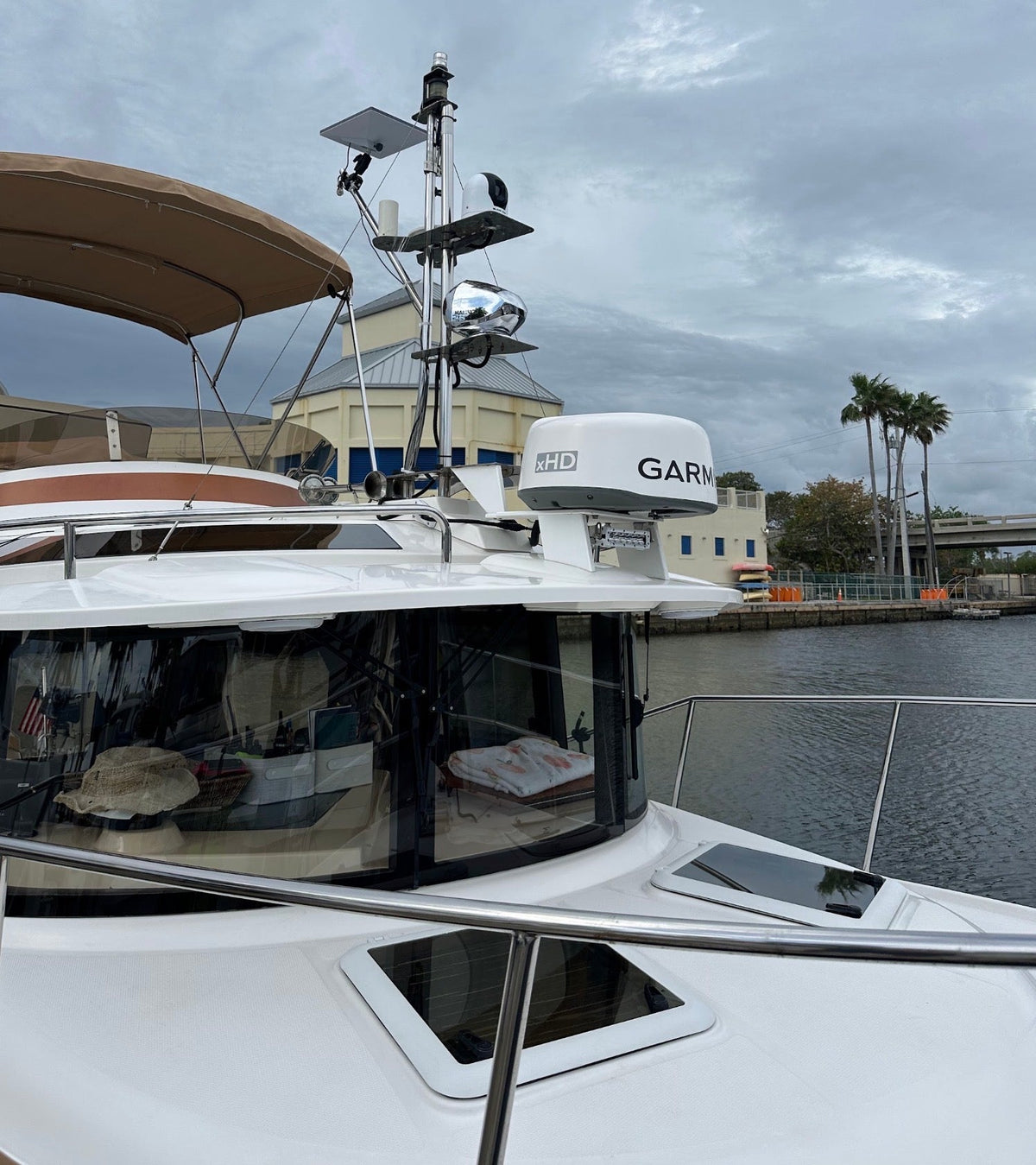
Steven mounted the Nitron XR1 on his tower, moving the TV antenna to the back to put the camera up front with a clear forward view. The 6-inch 850nm infrared light bar went in underneath the Garmin radar dome — a tidy piece of packaging that puts the IR source on the same axis as the camera without adding another mast fitting.
 The XR1 up top on the tower, with the TV antenna relocated aft to clear the forward view.
 The 6-inch 850nm IR bar tucked in below the Garmin dome — same axis as the camera, no extra mast hardware.
| Component | Detail |
|---|---|
| Nitron XR1 | Color night vision marine camera, tower mounted, forward facing. Hard-wired — no wireless link in the path. |
| 6-Inch 850nm IR Bar | Mounted below the radar dome. Floods the water ahead with infrared the camera reads clearly and the naked eye can't see. |
| Display | Garmin GPSMAP 7612, sharing the screen with the chart. RCA video connections to suit the older unit. |
| Just added | A 20-Inch Double Row LED Light Bar, courtesy of the October giveaway. |
On ScreenWhat It Actually Looks Like
This is the shot worth studying. A vessel moored ahead of him, in what Steven describes as complete darkness — no IR light running at all, nothing but stray ambient light from the marina.
 Moored vessels in full darkness on ambient marina light alone, no infrared. Steven's note: looking out the forward window, he couldn't see any of this.
There's a lesson buried in that image too, and Steven caught it himself: the marina's low-profile walkway lights are bright enough to wash out parts of the picture before you dial in contrast and brightness. A low-light camera is a genuinely sensitive instrument. Point it at a light source and it behaves like one — which is worth knowing when you first set yours up, because the fix is thirty seconds in the display settings, not a fault.
He's also run it where there's nothing at all to work with. Lake Cumberland has no shoreline homes, no road lights, and marinas scattered ten or more miles apart. Different end of the spectrum entirely, and it handled both.
Two more notes from him that are easy to overlook and genuinely useful:
- Rain. "It works in the rain great." Weather that scatters a spotlight beam straight back into your eyes doesn't trouble the camera the same way.
- Sun glare. "When the sun is setting and otherwise blinding, the camera still gives me forward view." Running west into a low sun is one of the genuinely dangerous lighting conditions on the water, and it's one most people never think to ask a night vision camera about.
Why We Picked ItWhat Made This Entry Stand Out
He Did the Homework
Compared every option on the market and called the engineers at each brand. A buyer like that choosing us is worth more than any ad we could run.
He Explained the Why
Latency, radar's blind spot, color versus thermal. He gave reasoning other boaters can actually use to make their own decision.
Real Miles, Real Water
Gulf Coast crab pots, a pitch-black Lake Cumberland, the ICW south to Miami, and Lake Superior. That's a lot of conditions on one camera.
You Could Be Next Month's Winner
Send us a photo or a video of your Black Oak gear doing something. Every submission is a separate entry, so more photos means better odds. We announce a new winner here on the blog every month.
How It WorksEntering Takes About Two Minutes
- Take the shot. Photo or video of your Black Oak gear on your boat, truck, UTV, or job site — whatever you run it on.
- Fill out the form. Head to the giveaway page and tell us what you're running and where.
- Upload it. Files up to 20MB each, or paste a link if it's bigger. Each submission counts as its own entry.
- Watch the blog. We pick a winner on merit every month, announce them here, and email them directly.
FAQCommon Questions
Wired or wireless — does it really matter?
Will it work with the chart plotter I already have?
Infrared or thermal — which should I get?
Do I need the infrared light, or is the camera enough?
Can I enter the giveaway more than once?
Wrap-UpCongratulations Again, Steven
Thanks for doing the research, and thanks for writing up the reasoning instead of just the verdict. The comparison you ran is more useful to other boaters than anything we could tell them ourselves.
Steven's heading back to the Gulf Coast in the spring before bringing the boat north to Lake Superior, and he's promised better photos and video once he's aboard. We'll post them when they land.
To everyone else: the entry form is open right now, and next month's winner is somebody who hasn't submitted yet. Get your entry in.
