Spot, flood or combo? It is the choice that decides what your light bar actually shows you at night: how far down the trail you can see, or how wide you can see around you. This guide explains each beam pattern with the real Black Oak LED angles, shows all three on the same dark trail, and matches each one to the way you drive, work, boat or hunt.
- Combo is the pick for most people. It puts a spot in the center of the bar and flood toward the ends, so one bar carries the distance and lights the sides, and you are not stuck guessing which job tonight will be. If you are buying one light bar, buy combo.
- Spot (15° spread) puts the light into a narrow, long beam. Step down to a dedicated spot only if you are certain you never need the sides lit, on open trails, fire roads or channels.
- Flood (45° spread) spreads the light wide and close. Step down to a dedicated flood only if your driving is always slow, close work with distance rarely mattering.
Not sure where to start? Shop combo LED light bars, our most versatile option and the one we point most buyers to first, or use the chart below if your use case is narrow enough to need a dedicated spot or flood.
- What is the difference between spot, flood and combo?
- What do the three beams look like on the same trail?
- How does a combo light bar work?
- Which beam should you choose?
- Side-by-side comparison
- Which Black Oak lights come in each beam?
- What else matters besides beam pattern?
- Shop by beam pattern
- Beam pattern FAQ
What is the difference between spot, flood and combo beams?
Every LED light bar has the same job: turn electricity into light and aim it. The beam pattern decides where that light lands. A spot reflector squeezes the light into a tight cone, so it carries far and the center is intense. A flood reflector fans the light out, so it covers a wide area but does not reach as far. A combo bar uses both kinds of optics in one housing.
On Black Oak LED light bars the specs are simple: spot is a 15° spread and flood is a 45° spread. The graphic below shows those angles from above, with the diffused 85° pod option added for reference.
Beam shapes of Black Oak LED lights from above. Angles come from the product specs. For one bar that does it all, run combo.
What do the three beams look like on the same trail?
The same dirt trail, the same camera position, three different beams. The spot lights a long, narrow strip and leaves the sides dark. The flood lights the trail and both banks but fades out sooner. The combo gives you the far reach of the spot and the wide fill of the flood together.


The same trail lit by each beam. Combo lights the trail, both sides and the far tree line in one even beam.
How does a combo light bar work?
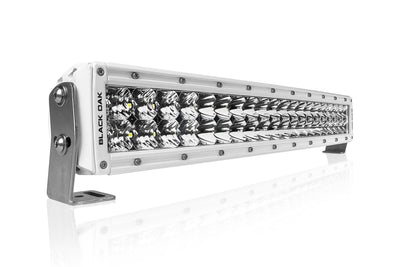
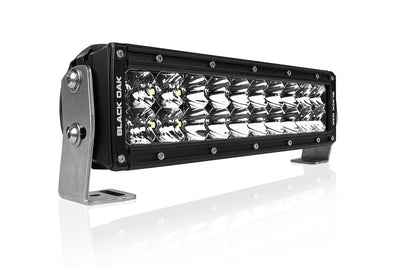
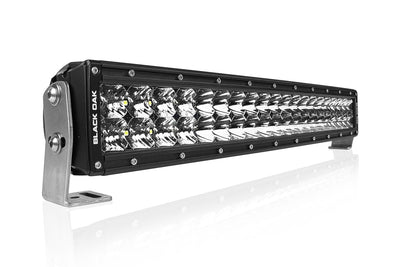
A combo bar is not a compromise beam. It is two sets of optics side by side. The reflectors in the center of the bar are spot reflectors. The ones toward the ends are flood reflectors. Turn the bar on and you get both patterns at once.
A combo bar from the front. Spot and flood optics blend into one even beam with no dark gaps.
One thing the pattern does not change is how much light the bar makes. The spec sheet lists one raw lumen figure per bar and wattage, whether you pick spot, flood or combo. The 20 inch double row, for example, lists 26,400 raw lumens in the 5 watt build and 14,900 in the 3 watt build. The beam pattern decides where those lumens go.
Which beam pattern should you choose?
Match the beam to the job, not to a number on a box. Pick the situation that sounds like yours.
At speed you need to see the next turn before you are in it. The center of a combo bar carries the light down the trail exactly like a dedicated spot, and the flood toward the ends keeps the shoulders lit when the trail bends or narrows. Drop to a dedicated spot only if you are certain you will never want the sides lit.
Start with off-road LED light bars or a 30 inch double row, both available in combo, and check the right size in our light bar size guide.
Slow technical driving and job sites are mostly about the area right around you, but combo still carries enough reach for the moments you need to see further out, which a dedicated flood cannot do. Choose a dedicated flood only if your work genuinely never needs distance, such as a fixed job site or rock garden you already know by heart.
Look at compact bars and pods in LED work light bars and pods, and see how bars and pods work together in LED pod lights vs. LED light bars.
For running a channel at night, a combo bar at the bow lets you read markers and the shoreline well ahead while still filling in close water, which is why it is the bow bar we recommend first. For the deck, dock and spreader area, flood gives even light without a hot spot. Marine housings come in white and black.
Browse marine LED light bars and read marine deck and spreader lighting for the layout.
For hunting, light color is the first decision and beam is the second. Combo reaches a fence line or the far edge of a field and still sweeps a nearby feeder or tree line without moving the light, which covers most hunters' nights in one bar. Step down to a dedicated spot or flood only if you already know your setup never changes, such as a stand with one fixed sight line.
Start with red vs green vs IR hunting lights, then shop hunting LED light bars.
This is the answer for most people, not a niche case. A combo bar gives you the reach of a spot and the fill of a flood in the same housing, so you are covered whether the night turns into fast open road or a tight technical stretch. Start here unless you already know for certain your driving never changes.
| Use | Spot | Flood | Combo |
|---|---|---|---|
| Fast trails and fire roads | Primary | Add-on | Primary |
| Slow rock crawling | Skip | Primary | Add-on |
| Work areas and job sites | Skip | Primary | Add-on |
| Boat bow and channels | Primary | Add-on | Primary |
| Boat deck and dock | Skip | Primary | Add-on |
| Hunting and field scanning | Primary | Add-on | Add-on |
| One bar for everything | Skip | Skip | Primary |
Guidance from how each pattern distributes light. Primary: the pattern to buy first. Add-on: a good second light. Skip: not what that job needs.
When in doubt, choose combo. It is the one we point most customers to first, because it performs well in every row above instead of winning only one.
Spot vs flood vs combo: how do they compare side by side?
| Beam | Spread | Strength | Trade-off |
|---|---|---|---|
| Spot | 15° | Reach and a bright center for seeing far ahead | Narrow, so the sides stay dark |
| Flood | 45° | Wide, even light close in and at the edges | Does not carry as far |
| Combo | 15° center + 45° ends | Distance and width in one bar | Neither zone is as big as a dedicated spot or flood bar |
| Diffused (pods) | 85° | Very wide, close work and rear lighting | Shortest reach of the four |
Angles from Black Oak LED product specs. The DTR 2 pod also offers a driving lens, the widest of its three lenses; Black Oak does not publish an angle for it.
Which Black Oak lights come in each beam pattern?
| Light | Beam options |
|---|---|
| Double row bars, 6 to 60 inch | Spot (15°), flood (45°) or combo |
| Single row bars | Spot, flood or combo optics |
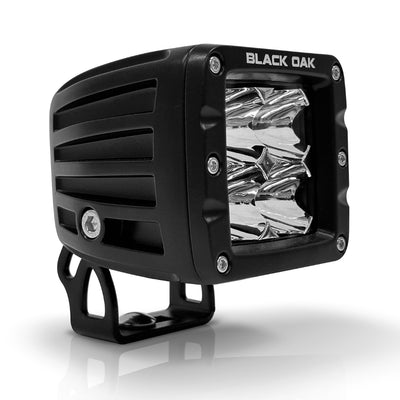
| 2 inch pods (pair) | Spot (15°) or flood (45°) |
| DTR 2 pods (pair) | Spot, driving or combo |
| 2 inch flush mount pods | Flood (45°) or diffused (85°) |
| 4 inch pod | Combo |
What else matters besides beam pattern?
Size and mounting. A longer bar gives a wider footprint, and where you mount it changes what the beam does. A roof bar reaches over the hood. A bumper bar lights the ground ahead. Our light bar mounting locations guide walks through each spot, and the size guide helps with fit.
3 watt or 5 watt. Most double row bars come in a 3 watt and a 5 watt build. On the 20 inch double row that is 120W and 14,900 raw lumens versus 200W and 26,400 raw lumens, on the same 12 to 30V DC system. The 5 watt build is the higher-output option.
Built for the conditions. Black Oak LED lights are military grade and IP69K rated, which means the housing is sealed against high-pressure, high-temperature water jets and dust, the top of the IP scale. Spot, flood or combo, the bar takes rain, mud and wash-down, with an operating range from -40°F to 145°F.
Aim. Aim a bar so the hot center lands where you want it, not in oncoming eyes. Power it, park on level ground and check it against a wall before you drive. Use off-road lighting where the law allows, and follow local rules for public roads.
Shop Black Oak LED lights by beam pattern
Every light below links to its live product page. Pick the beam on the product page, where each option is listed.
 10 inch double rowSpot, flood, combo
 20 inch double rowSpot, flood, combo
 30 inch double rowSpot, flood, combo
 50 inch curvedSpot, flood, combo
 6 inch marineSpot, flood, combo
 20 inch single rowSpot, flood, combo
 2 inch podsSpot or flood
 2 inch marine podsSpot or flood
 DTR 2 podsSpot, driving, combo
 4 inch podCombo
 Flush mount podsFlood or diffused
Shop all LED light barsShop LED light pods
Spot vs flood vs combo: frequently asked questions
What is the difference between a spot and a flood light bar?
A spot light bar focuses the light into a narrow 15° beam that reaches far. A flood light bar spreads it across a wider 45° beam that covers more area but does not carry as far. Neither makes more light; they send the same light to different places.
Is a combo beam the right choice for most people?
Yes, for most people. A combo bar puts spot optics in the center and flood optics toward the ends, so you get distance and width together in the one light most buyers actually need. Choose a dedicated spot or flood only if you can say for certain your driving is always fast open trail, or always slow work close to the vehicle.
What are the beam angles on Black Oak LED light bars?
Spot is a 15° spread and flood is a 45° spread. Combo uses both. On pods, the flush mount diffused option is an 85° spread. The product page for each light lists its options.
Does the beam pattern change how bright the bar is?
Not the total output. The spec sheet lists one raw lumen figure per bar and wattage across all patterns. A spot looks brighter at the center because the same light is packed into a smaller area.
Can I run a spot bar with flood pods?
Yes, and it is a common setup, though most people get the same result from one combo bar instead of pairing two. A spot or combo bar carries the distance while flood pods at the corners or A-pillars light the sides. See LED pod lights vs. LED light bars for placements.
What is a driving beam?
The DTR 2 pods come with spot, driving and combo lenses. Driving is the widest of those three. Black Oak does not publish a beam angle for the driving lens, so compare it by name rather than by degrees.
Which beam is better for boats and for hunting?
For both, combo is the easiest starting point: it reads the channel or the field at distance while still filling in what is close. For boats, a dedicated spot bar at the bow is still an option if you never need the deck lit from the same light, and a flood still lights the deck itself. For hunting, choose the light color first, then combo to cover most nights in one bar. The marine and hunting links above lead to guides for each.
Designed and engineered in Sarasota, Florida.